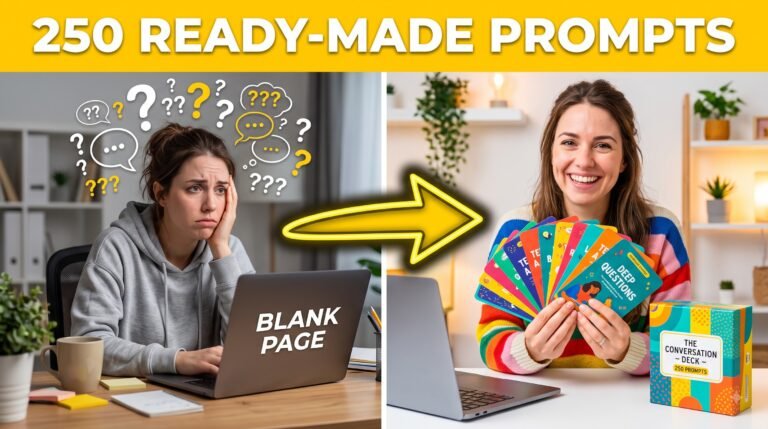


Prompt2Deck is a prompt library for digital product creators, printable sellers, and AI-assisted publishers who want to build conversation card decks — the kind sold as physical games, Etsy printables, or digital downloads.
Conversation cards already sell across several buyer-friendly categories at once: games, gifts, printables, relationship activities, and family activities. Buyers already understand what a conversation deck is, how to use it, and why it makes a good gift or activity — so there’s no category education needed before you can sell one. The harder part has always been going from “a pile of questions” to something that looks and feels like a finished, packaged product. That’s the specific gap Prompt2Deck is built to close.
Instead of handing you a pile of disconnected questions, each of the 250 prompts is written as a full product brief — the kind of planning you’d normally have to do manually before you ever started writing individual cards. Choose a market and a deck format, and the prompt is already pre-loaded with the buyer, use occasion, tone, exact card count, card mix, and a recommended visual starting point. You paste that single prompt into a capable AI assistant, and it’s instructed to carry the product all the way from positioning through the full card set, the visual system, and the marketplace assets, ending in a quality-control pass — not just generate a batch of text and stop.
The underlying idea is that AI has already made generating questions fast and easy. What it hasn’t automated is the harder, more valuable part: deciding what to create, structuring the deck properly, keeping the design consistent across every card, and packaging the result into something a buyer can actually understand, download, print, or gift. Prompt2Deck’s structure is aimed squarely at that gap, rather than at producing more raw questions.
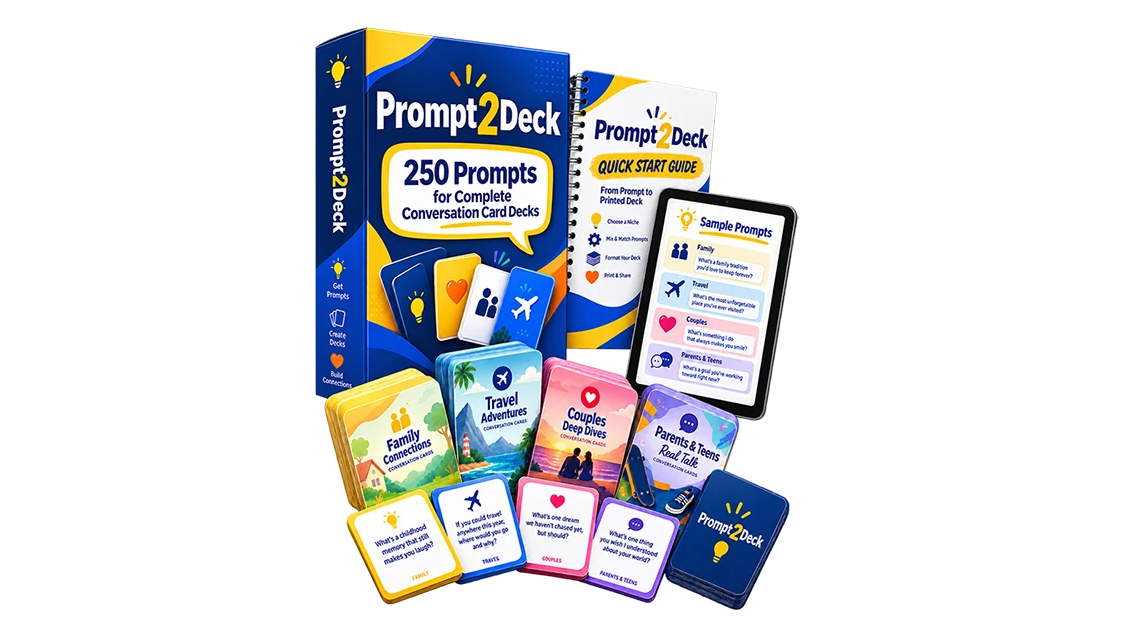
- 250 complete-product prompts across 25 evergreen markets (first dates, married couples, siblings, remote teams, book clubs, travel lovers, and more)
- 10 deck formats per market — from fast Quick Connect icebreakers to a premium Ultimate Mixed Deck
- The DeckFlow™ production sequence: audience lock → product positioning → deck architecture → full card set → visual concept → master mockup → visual consistency lock → card-by-card visual implementation → marketplace assets → quality control


Pricing and Upgrade Path
The front end — Prompt2Deck: 250 Prompts for Complete Conversation Card Decks — is a $27 one-time purchase. Beyond that, there are five optional upgrades, each aimed at a different stage of the same “create → gamify → design → sell → expand → serve clients” workflow. None of them are required to use the front end.
OTO 1 — PlayLoop PRO Interactive Card Game Engine ($27) The gamification layer. It takes a deck you’ve already built and adds replayability: 12 play engines, 120 deck-conversion prompts, 30 optional scoring systems, 20 round structures, and 20 wild mechanics — without rebuilding the deck from scratch.
OTO 2 — Deck Designer Production Kit ($37) The visual-production layer. It’s aimed at keeping 80–150 cards visually consistent instead of treating every card as its own design project, with 50 reusable visual design systems, 20 bulk-production templates, cover and instruction-card systems, mockup systems, and a QA/export workflow.
OTO 3 — Deck Marketplace Profit Engine ($27) The marketing layer, for listing and promoting a finished deck: 275 marketplace and promotion prompts, 11 marketing modules, a listing and positioning workflow, keyword/image/bundle/campaign prompts, claim-safety guidance, and 15 evergreen campaign structures.
OTO 4 — Prompt2Deck: Micro-Niche Deck Vault 750 ($47) The catalog-expansion layer. It extends the FE’s 25 broad markets into 750 additional complete-product prompts across 75 specific micro-niches, with 10 deck archetypes per micro-niche, following the same FE-aligned architecture.
OTO 5 — ClientDeck Commercial & Agency Upgrade ($67) The client-service layer, for anyone wanting to take on paid deck projects: a commercial/agency license template and rights matrix, a 40-question client intake, a 12-stage client workflow, pricing and proposal tools, and revision/email/delivery resources.
| Stage | Product | Role | Price |
|---|---|---|---|
| FE | Prompt2Deck | Create complete deck products | $27 |
| OTO 1 | PlayLoop PRO | Gamify existing decks | $27 |
| OTO 2 | Deck Designer Production Kit | Design & bulk-produce | $37 |
| OTO 3 | Deck Marketplace Profit Engine | List & promote finished decks | $27 |
| OTO 4 | Micro-Niche Deck Vault 750 | Expand catalog inventory | $47 |
| OTO 5 | ClientDeck Commercial & Agency Upgrade | Structure paid client projects | $67 |
Worth being clear about: none of the upgrades are required to use the front end on its own, and — per the product’s own positioning — the value here is workflow structure and reusable production systems, not a guarantee of sales, marketplace approval, or income.
Coupon Code:Prompt2Deck — 250 Prompts For Complete Conversation Card Decks

Evaluation: Pros and Considerations
Pros
- Structured starting point — each prompt maps positioning, architecture, and content before a single card is written, instead of leaving you with a pile of disconnected questions
- Product variety — 25 evergreen markets × 10 deck formats on the front end alone, extendable to 75 micro-niches through OTO 4
- Visual-production focus — a defined visual system and Visual Consistency Lock, rather than leaving cover, card-back, and layout decisions entirely up to you
- Reusable workflow — the same DeckFlow™ sequence applies to every new niche or format, so you’re not rebuilding your process each time
Considerations
- AI output still needs review — the prompts generate a full draft, but you’re expected to check, edit, and approve everything before publishing or selling
- Visuals may need refinement — the recommended design concept and mockup are a starting point, and turning them into final print-ready files still takes some design effort
- Marketplace success is not guaranteed — the product itself is explicit that it’s a development system, not a promise of traffic, conversions, marketplace approval, or income
- The full value ladder adds up — the front end is $27, but the complete FE-through-OTO-5 funnel totals $232 if every upgrade is purchased, so it’s worth deciding upfront which stages you actually need
Use Coupon Code: Prompt2Deck — 250 Prompts For Complete Conversation Card Decks
The Bottom Line
Prompt2Deck isn’t selling you 250 one-line ideas — it’s selling a repeatable system for turning a niche into a fully specified product: positioning, architecture, full card set, visual identity, and the marketplace assets you’d need to actually list it. For someone already comfortable using AI tools and wanting to stop reinventing the production process for every new deck, that structure is the real value here. It’s currently available as a $27 one-time front-end offer.
♦ Step 2: After your purchase goes through, you will get all the bonuses through email.